D# Minor Ukulele Chord
A darkly expressive triad drawn from D#, F# and A#. Less common but striking, it adds tension and depth to moody passages and works in keys like D# minor and F# major.
Also known as
- D#m
- D#-
- Ebm
- Eb-
- D# m
- Eb m
- D#min
- Ebmin
- D# min
- Eb min
- D#minor
- Ebminor
- E-flatm
- E-flat-
- D# minor
- D-sharpm
- D-sharp-
- Eb minor
- E-flat m
- D-sharp m
- E-flatmin
- D-sharpmin
- E-flat min
- D-sharp min
- E-flatminor
- D-sharpminor
- E-flat minor
- D-sharp minor
How to Play This Chord
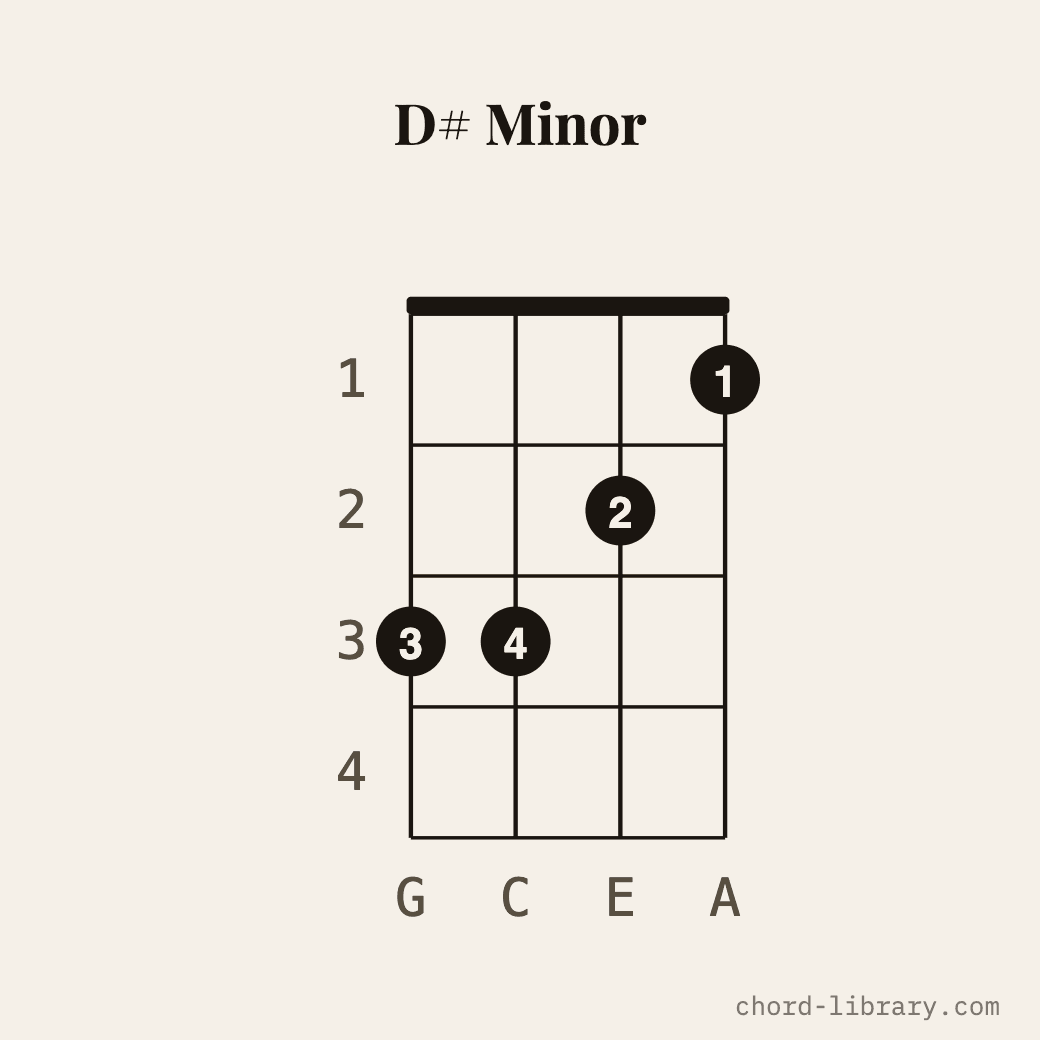
Position your fingers on the fretboard as shown in the diagram. The vertical lines represent the four strings, from the top G string (left) to the A string (right), and the horizontal lines are the frets. Numbers inside the dots indicate which finger to use: 1 (index), 2 (middle), 3 (ring), 4 (pinky). An X means don't play that string; an O means play it open. A bar spanning multiple strings means one finger presses across all of them at once — this is known as a barre chord.
Tips & Tricks
Stagger your fingers across three frets: index on the first fret of the A string, middle on the second fret of the E string, then ring and pinky on the third fret of the G and C strings. The diagonal shape feels awkward at first, so anchor the index low and let the others fall into their frets above it. Keep each fingertip arched to avoid muting neighbors.
There are many ways to play this chord. Try these:
Download this chord chart
Save the diagram as a high-resolution image — perfect for printing, sharing, or your practice notes.
Download PNG