G#m7♭5 Ukulele Chord
A compact, shadowy chord, G#m7♭5 stacks G#, B, D and F# for a half-diminished sound with smooth jazz tension. It functions as the ii in a minor ii-V-i and slots neatly into moody standards and reflective, sophisticated progressions.
Also known as
- G#ø
- Abø
- G# ø
- G#ø7
- Ab ø
- Abø7
- G# ø7
- Ab ø7
- G#m7b5
- Abm7♭5
- Abm7b5
- G# m7♭5
- G# m7b5
- Ab m7♭5
- Ab m7b5
- A-flatø
- G-sharpø
- A-flat ø
- A-flatø7
- G-sharp ø
- G-sharpø7
- A-flat ø7
- G#half-dim
- G-sharp ø7
- Abhalf-dim
- A-flatm7♭5
- A-flatm7b5
- G# half-dim
- G#half-dim7
- G-sharpm7♭5
- G-sharpm7b5
- Ab half-dim
- Abhalf-dim7
- A-flat m7♭5
- A-flat m7b5
- G# half-dim7
- G-sharp m7♭5
- G-sharp m7b5
- Ab half-dim7
- A-flathalf-dim
- G-sharphalf-dim
- A-flat half-dim
- A-flathalf-dim7
- G-sharp half-dim
- G-sharphalf-dim7
- A-flat half-dim7
- G-sharp half-dim7
- G# half-diminished 7th
- Ab half-diminished 7th
- G# half-diminished seventh
- Ab half-diminished seventh
- A-flat half-diminished 7th
- G-sharp half-diminished 7th
- A-flat half-diminished seventh
- G-sharp half-diminished seventh
How to Play This Chord
Position your fingers on the fretboard as shown in the diagram. The vertical lines represent the four strings, from the top G string (left) to the A string (right), and the horizontal lines are the frets. Numbers inside the dots indicate which finger to use: 1 (index), 2 (middle), 3 (ring), 4 (pinky). An X means don't play that string; an O means play it open. A bar spanning multiple strings means one finger presses across all of them at once — this is known as a barre chord.
Tips & Tricks
Walk your fingers diagonally across the strings — index on the G string at fret 1, then middle, ring and pinky climbing onto the C, E and A strings at fret 2. Keeping the pinky firm and arched is the tricky part, so press on your fingertips and keep each one clear of the next string.
There are many ways to play this chord. Try these:
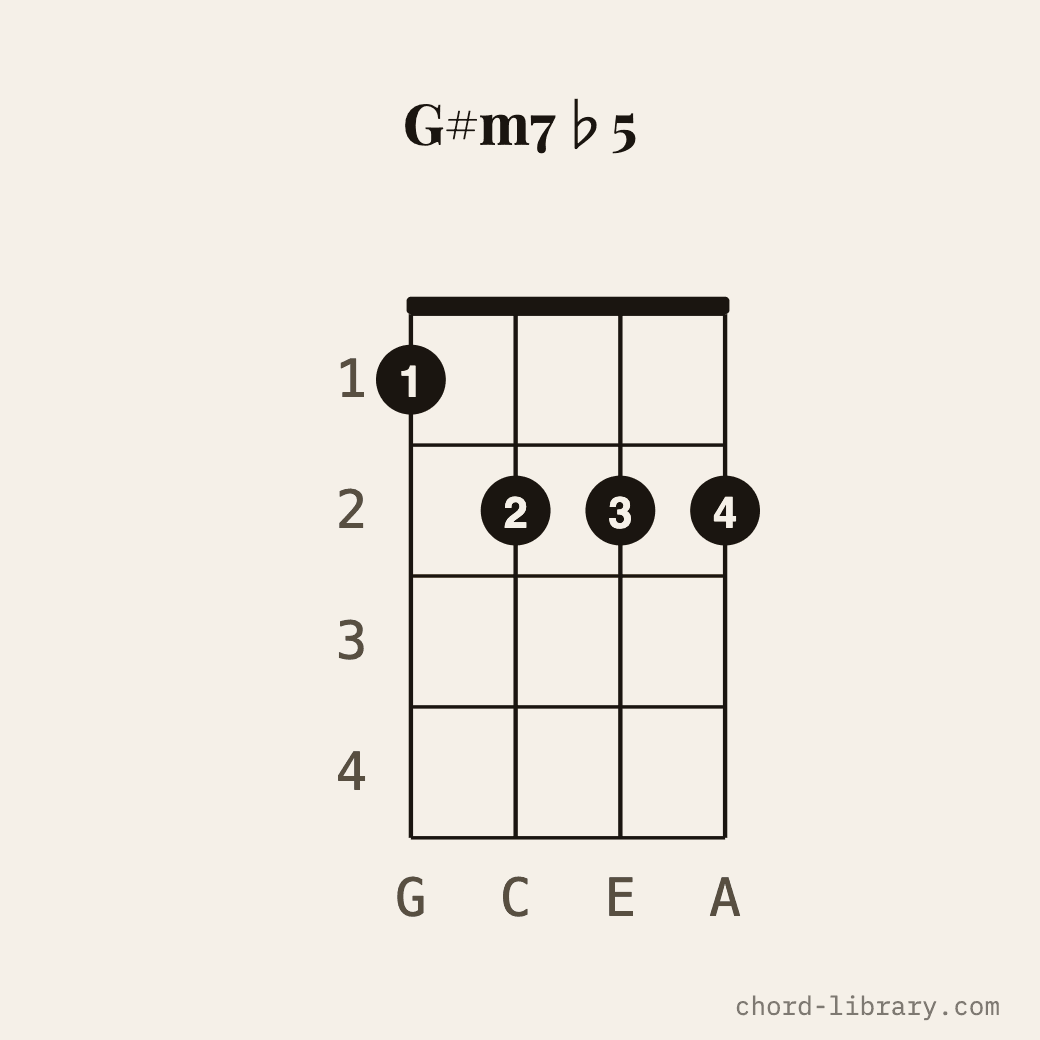
Download this chord chart
Save the diagram as a high-resolution image — perfect for printing, sharing, or your practice notes.
Download PNG