F#dim Ukulele Chord
A light yet uneasy diminished triad built from F#, A and C. Its minor-third stack gives it a tense, unresolved color, so it most often acts as a passing chord nudging toward the next harmony in jazz, classical and dramatic pop.
Also known as
- F#°
- Gb°
- F# °
- Gb °
- Gbdim
- F# dim
- Gb dim
- G-flat°
- F-sharp°
- G-flat °
- F-sharp °
- G-flatdim
- F-sharpdim
- G-flat dim
- F-sharp dim
- F#diminished
- Gbdiminished
- F# diminished
- Gb diminished
- G-flatdiminished
- F-sharpdiminished
- G-flat diminished
- F-sharp diminished
How to Play This Chord
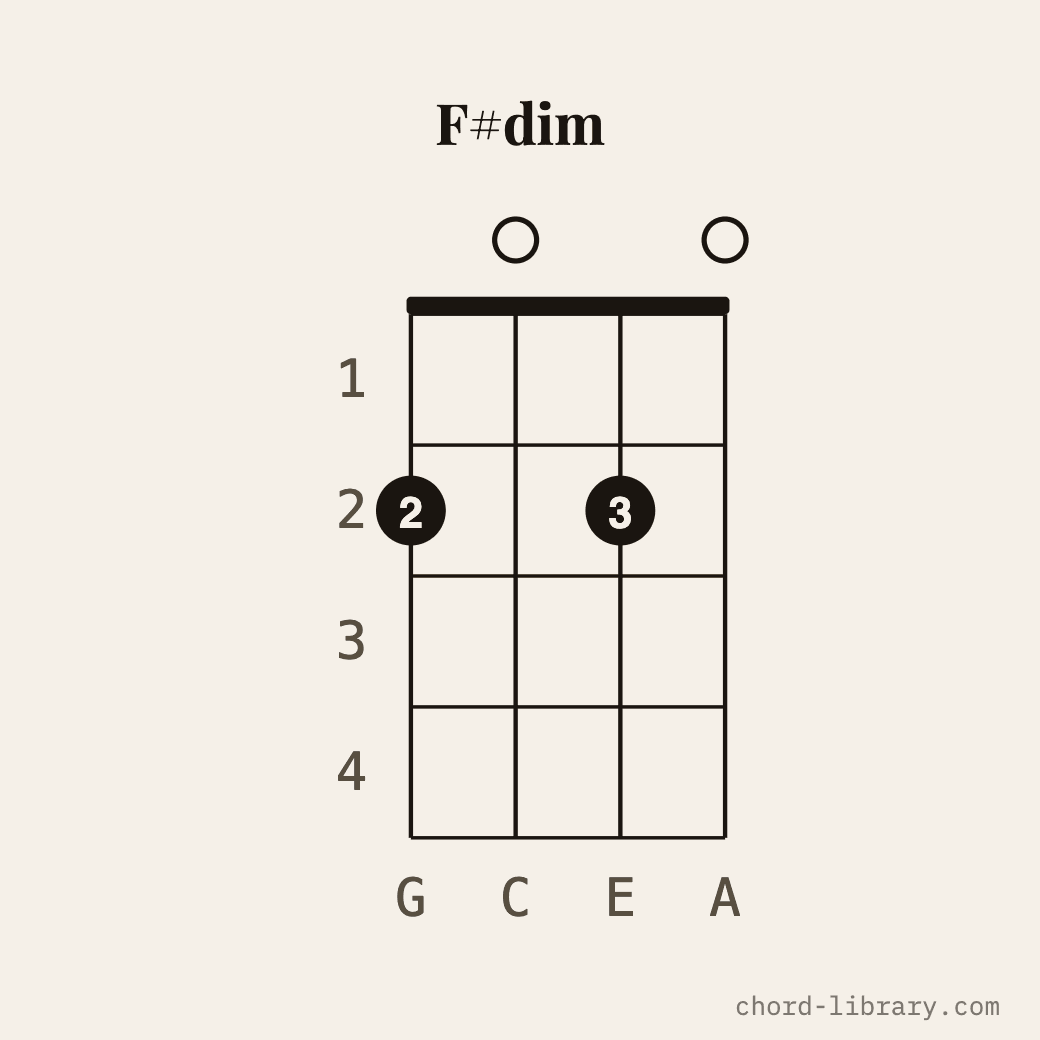
Position your fingers on the fretboard as shown in the diagram. The vertical lines represent the four strings, from the top G string (left) to the A string (right), and the horizontal lines are the frets. Numbers inside the dots indicate which finger to use: 1 (index), 2 (middle), 3 (ring), 4 (pinky). An X means don't play that string; an O means play it open. A bar spanning multiple strings means one finger presses across all of them at once — this is known as a barre chord.
Tips & Tricks
This one is friendly because two strings stay open: leave the C and A strings ringing, then place your middle finger on the G string at the second fret and your ring finger on the E string at the second fret. Keep both fretting fingers arched on their tips so they don't brush the open C and A strings and choke them.
There are many ways to play this chord. Try these:
Download this chord chart
Save the diagram as a high-resolution image — perfect for printing, sharing, or your practice notes.
Download PNG