C#m7 Ukulele Chord
Built from C#, E, G# and B, this minor seventh has a soft, dreamy character that takes the edge off a plain minor chord. It sits comfortably in jazz, soul and pop ballads, often serving as a gentle, restful stop in keys like E major or B major.
Also known as
- C#-7
- Dbm7
- Db-7
- C# m7
- C# -7
- Db m7
- Db -7
- C#min7
- Dbmin7
- C# min7
- Db min7
- D-flatm7
- D-flat-7
- C-sharpm7
- C-sharp-7
- D-flat m7
- D-flat -7
- C-sharp m7
- C-sharp -7
- D-flatmin7
- C-sharpmin7
- D-flat min7
- C-sharp min7
- C# minor 7th
- Db minor 7th
- C# minor seventh
- Db minor seventh
- D-flat minor 7th
- C-sharp minor 7th
- D-flat minor seventh
- C-sharp minor seventh
How to Play This Chord
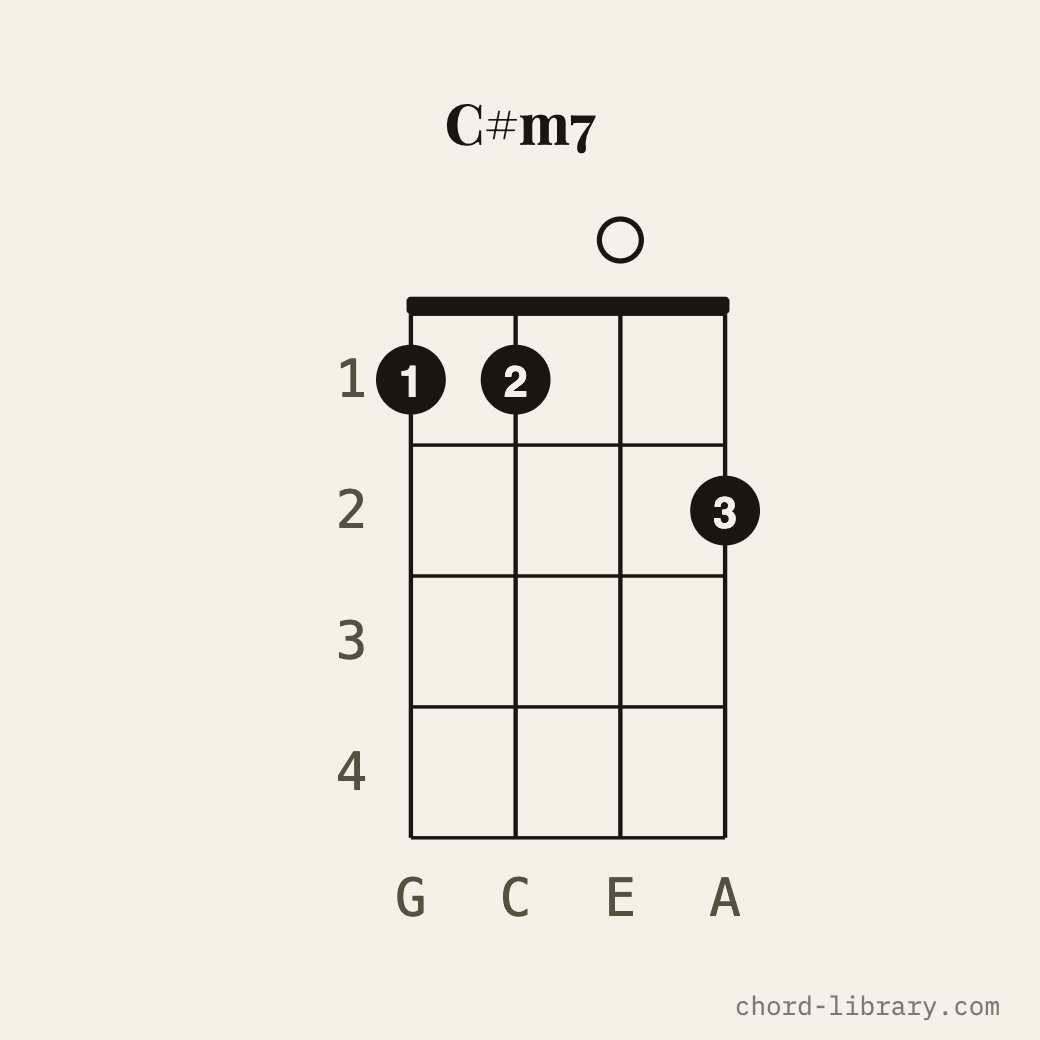
Position your fingers on the fretboard as shown in the diagram. The vertical lines represent the four strings, from the top G string (left) to the A string (right), and the horizontal lines are the frets. Numbers inside the dots indicate which finger to use: 1 (index), 2 (middle), 3 (ring), 4 (pinky). An X means don't play that string; an O means play it open. A bar spanning multiple strings means one finger presses across all of them at once — this is known as a barre chord.
Tips & Tricks
Index goes on the G string at the first fret while middle takes the C string, also at the first fret; ring presses the A string at the second fret, and the E string stays open. Keep the E ringing clearly by arching your ring finger so it doesn't lean against it, and let the open string sing.
There are many ways to play this chord. Try these:
Download this chord chart
Save the diagram as a high-resolution image — perfect for printing, sharing, or your practice notes.
Download PNG