A#dim7 Ukulele Chord
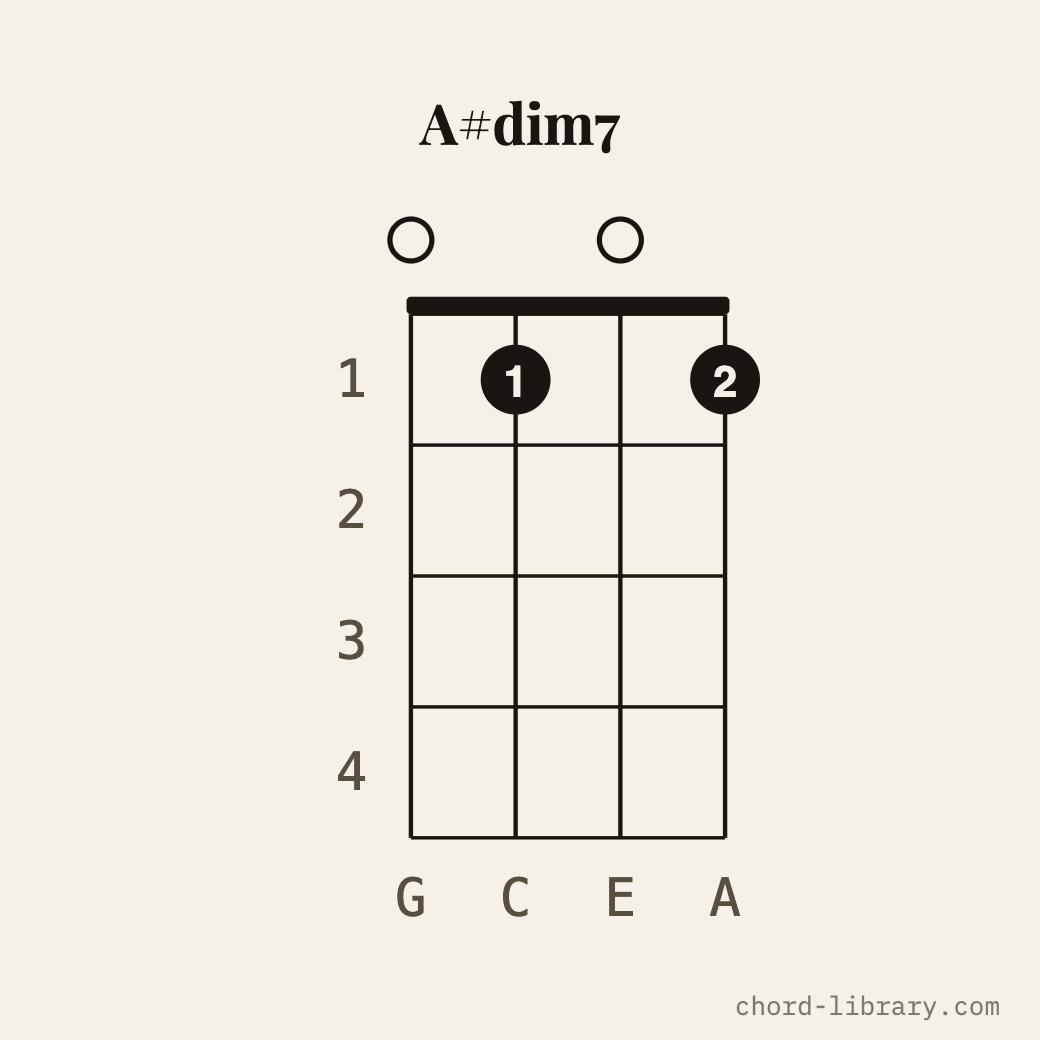
An open, hollow-sounding diminished seventh made of A#, C#, E and G. Tense and expectant, it works as a passing and leading-tone chord in jazz, swing and dramatic minor-key progressions.
Also known as
- A#°7
- Bb°7
- A# °7
- Bb °7
- Bbdim7
- A# dim7
- Bb dim7
- B-flat°7
- A-sharp°7
- B-flat °7
- A-sharp °7
- B-flatdim7
- A-sharpdim7
- B-flat dim7
- A-sharp dim7
- A# diminished 7th
- Bb diminished 7th
- A# diminished seventh
- Bb diminished seventh
- B-flat diminished 7th
- A-sharp diminished 7th
- B-flat diminished seventh
- A-sharp diminished seventh
How to Play This Chord
Position your fingers on the fretboard as shown in the diagram. The vertical lines represent the four strings, from the top G string (left) to the A string (right), and the horizontal lines are the frets. Numbers inside the dots indicate which finger to use: 1 (index), 2 (middle), 3 (ring), 4 (pinky). An X means don't play that string; an O means play it open. A bar spanning multiple strings means one finger presses across all of them at once — this is known as a barre chord.
Tips & Tricks
One of the easiest grips here: leave the G and E strings open and let them ring, place your index on the C string at fret 1, and add your middle on the A string at fret 1. Keep your fretting fingers curled away from the open strings so the bright, unresolved color comes through clearly.
There are many ways to play this chord. Try these:
Download this chord chart
Save the diagram as a high-resolution image — perfect for printing, sharing, or your practice notes.
Download PNG